

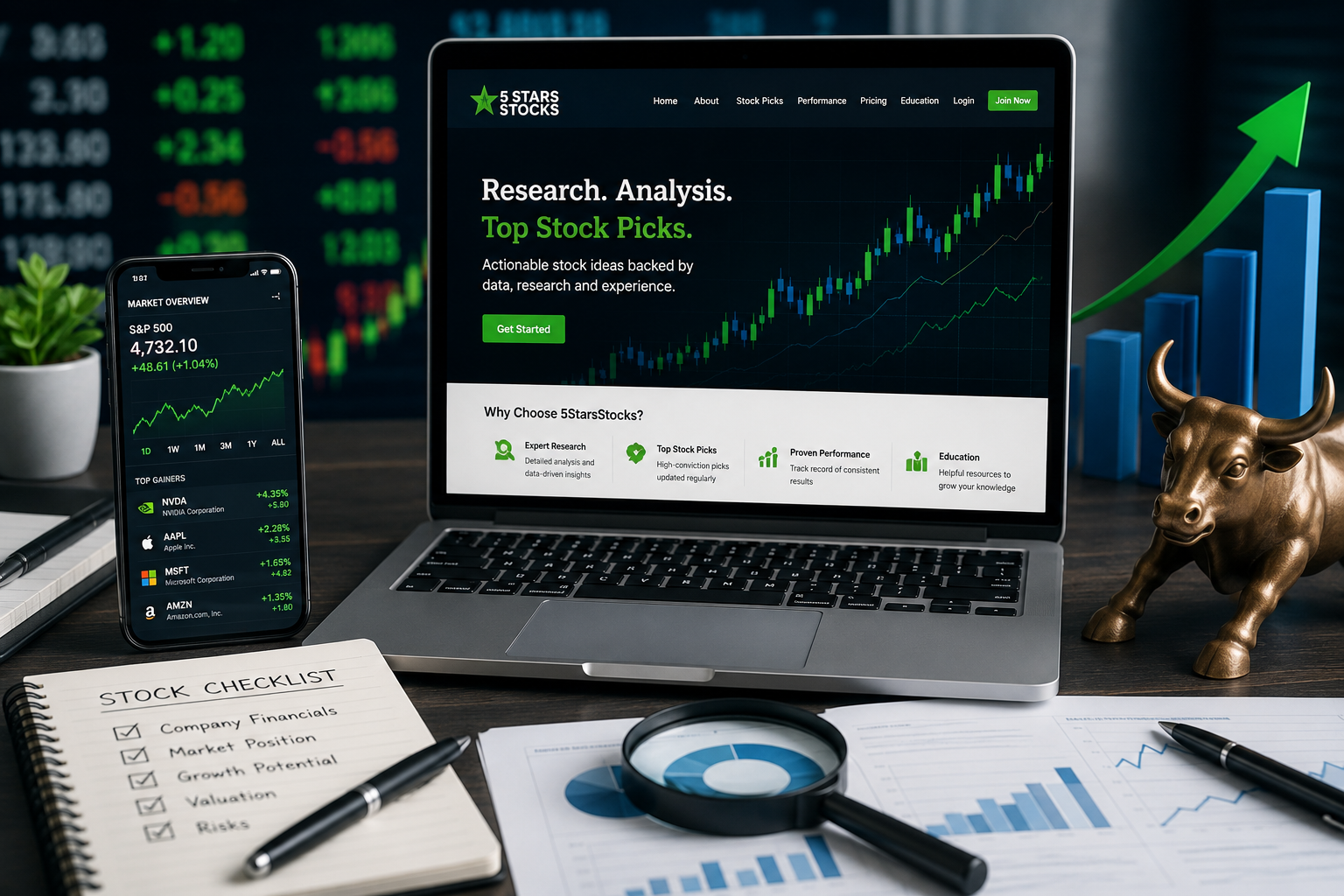
Anyone scrolling through investing forums or search results lately has likely come across 5starsstocks .com. It markets itself as an AI-driven research platform, promising to simplify stock picking through a five-star rating system, sector breakdowns, and algorithm-generated recommendations. For someone tired of sifting through jargon-heavy financial reports, that pitch is appealing.
But before treating any stock recommendation platform as a shortcut to smart investing, it’s worth understanding exactly what this site claims to do, how it positions itself compared to established financial resources, and what independent reviewers have actually found when they tested it. This article walks through all of that in plain language, without leaning on the platform’s own marketing copy as the primary source of truth.
What 5starsstocks .com Says It Does
According to its own site, the platform combines artificial intelligence with market data analysis to generate stock recommendations across sectors like technology, healthcare, renewable energy, and niche categories such as lithium and 3D printing. It describes a five-star rating system that scores stocks on fundamentals, valuation, growth potential, market sentiment, and risk — five separate factors condensed into a single, easy-to-scan number.
The pitch is that instead of digging through earnings reports and analyst notes yourself, the platform’s algorithm does the heavy lifting and hands you a simplified score. It also offers educational content, live market quotes, sector performance tracking, and an economic calendar, positioning itself as a one-stop hub rather than just a tip sheet.
This is a common structure among newer fintech content sites — part education, part recommendation engine, wrapped in a clean dashboard designed to feel approachable to beginners.
The Gap Between Marketing and Verification
Here’s where things get more complicated. Several independent reviews of 5starsstocks .com have pointed out that the platform’s ownership and operating team are not publicly disclosed. There’s no named founder, no visible company registration, and no team page explaining who is actually behind the analysis being published.
That matters more than it might first seem. When a platform is making financial recommendations, anonymity removes accountability. If a recommendation leads to a loss, there’s no clear entity to hold responsible, and no way to verify whether the people producing the analysis have any regulated financial background at all.
It’s also worth noting that the site does not appear to be registered with major financial regulatory bodies, the kind of oversight that governs licensed financial advisers and brokerages in most countries. That doesn’t automatically make a platform illegitimate — plenty of educational content sites operate without needing that kind of registration — but it does mean users don’t have the legal protections that come with regulated advice if something goes wrong.
What Independent Testing Actually Found
One of the more telling details to emerge from third-party reviews involves the platform’s own accuracy claims. 5starsstocks .com reportedly states that its AI-driven analysis achieves around 70% accuracy, but no methodology, testing period, or independent benchmark is provided to support that figure.
At least one independent reviewer went further and built sample portfolios based on the platform’s recommendations to test them directly. The results were noticeably different from the platform’s stated claims — actual accuracy came in closer to 35%, and the test portfolios reportedly lost value over the period reviewed rather than gaining it.
This kind of discrepancy is exactly why financial claims should never be taken at face value, regardless of how polished the presentation looks. A number quoted on a company’s own homepage, without a visible testing methodology behind it, is a marketing claim until proven otherwise, not a verified statistic.
The “Black Box” Problem
Reviewers commonly describe platforms like this one as having a “black box” problem. Users see the output — a star rating and a buy or hold suggestion — but they can’t see the reasoning behind it. There’s no visibility into what data the model was trained on, how it weighs different signals, or how frequently it updates its analysis. For a tool making financial suggestions, that opacity is a real limitation rather than a minor design choice.
This lack of transparency isn’t unique to one platform. It’s a recurring criticism across a wide range of AI-powered fintech tools, where the promise of sophisticated analysis often outpaces the ability to actually verify how that analysis works. For casual users, the star rating feels authoritative simply because it’s presented cleanly, but a clean interface says nothing about the quality of what’s underneath it.
How 5starsstocks .com Compares to Established Resources
It helps to compare this kind of service against resources that have a long, verifiable track record. Platforms like established financial data providers offer comprehensive market data, verified news sourcing, and regulatory compliance built up over years of operation and public scrutiny. Educational resources with transparent, published methodologies are generally a safer starting point for beginners than recommendation-focused tools with undisclosed logic, simply because you can check their work.
That’s not to say a newer, AI-driven service has zero value. It may work reasonably well as a supplementary tool, something that surfaces sectors or companies worth researching further. But treating it as a replacement for due diligence, or worse, as a substitute for licensed financial advice, puts users at a real disadvantage.
Third-Party Credibility Signals
Website credibility checkers have rated 5starsstocks .com in an ambiguous middle range, not a score that confirms outright fraud, but not one that signals a clean bill of health either. That kind of rating typically reflects a combination of factors: anonymous ownership, limited operating history, and a lack of transparency around methodology.
It’s worth treating this kind of middling score for what it is: a signal to dig deeper, not a verdict either way. A platform can be legitimate but simply new and under-documented, or it can be built primarily around marketing language with weak substance behind it. The only way to tell the difference is independent verification, not a single trust score.
Why Anonymous Ownership Matters More in Finance
It’s worth pausing on the ownership question a little longer, because it’s easy to underestimate how much it matters. In most industries, an anonymous website is a minor inconvenience. In finance, it changes the entire risk calculation.
When a stock recommendation platform has a named, licensed operator, there’s a paper trail. Regulators can investigate complaints, users can pursue legal remedies if advice was negligent or fraudulent, and the operator has a professional reputation at stake that discourages reckless recommendations. None of that exists when a site has no disclosed leadership.
This doesn’t mean every anonymously run financial site is dishonest. Some are simply run by individuals or small teams who haven’t formalized their business structure yet, particularly newer entrants still building an audience. But from a user’s perspective, the practical effect is the same either way: there’s no one to hold accountable if the guidance turns out to be poor, and no way to verify credentials before you start relying on it.
Weighing Convenience Against Risk
The appeal of a platform offering simplified, AI-generated stock picks is understandable. Traditional research is time-consuming, and star ratings feel like a shortcut past all that effort. But convenience and reliability are not the same thing, and it’s worth being honest with yourself about which one you’re actually optimizing for when you use a tool like this.
A five-star rating condenses a huge amount of financial complexity into a single number. That compression is useful for grabbing attention, but it necessarily strips out context — why a company received that score, what assumptions went into the model, and how confident the system actually is in its own output. Treating a condensed score as equivalent to real due diligence is where users tend to run into trouble.
If you’re considering using a recommendation platform like this, a few practical habits go a long way. Never treat any single recommendation as a final decision — cross-reference stock suggestions against established financial databases, company filings, and multiple independent sources before acting on them.
Start small if you decide to test the platform’s suggestions at all. Position sizing matters here: allocating only a small percentage of a portfolio to speculative or unverified recommendations limits the damage if the analysis turns out to be weak. Diversification across sectors and asset types provides further protection against any single tool’s blind spots.
It’s also worth consulting a licensed financial advisor before making significant decisions, particularly if the amounts involved are meaningful to your overall financial picture. Professional guidance accounts for your personal circumstances in a way that a generic AI-generated star rating simply cannot.
Reading the Platform’s Content Critically
Even the educational material found on sites like this should be read with a critical eye rather than passive trust. Content that explains sector trends or market cycles can be genuinely useful for building general financial literacy, but it’s worth checking whether that content cites verifiable data or simply asserts trends without sourcing.
A useful test is whether the explanations help you understand why a market or sector behaves a certain way, versus whether they’re primarily steering you toward a specific stock or category the platform happens to be promoting. Genuine education builds your own judgment; a recommendation engine wrapped in educational language is designed to build reliance on the tool instead.
Final Thoughts
5starsstocks .com presents itself as an accessible, AI-powered way to cut through the noise of stock market research, and for some users, the clean interface and sector breakdowns may offer a useful starting point. But the platform’s undisclosed ownership, lack of regulatory registration, and the gap between its claimed accuracy and what independent testing has found are all reasons to approach it with real caution.
Use platforms like this as one input among many, not as a standalone source of truth. Verify claims independently, size any decisions based on this kind of guidance conservatively, and lean on regulated, transparent resources for anything that meaningfully affects your financial future. Curiosity about a tool like 5starsstocks .com is reasonable — blind trust in it isn’t.
Frequently Asked Questions
Is this platform a licensed financial advisory service? No. The platform does not appear to be registered with major financial regulatory bodies, which means it operates outside the disclosure and conduct standards that govern licensed advisers and brokerages. Any recommendations should be treated as a starting point for research, not professional financial advice.
Who owns or operates 5starsstocks .com? The ownership and operating team behind the platform are not publicly disclosed. There’s no named founder, visible company registration, or team page, which limits accountability if recommendations lead to losses.
Is the platform free to use? Basic access is reportedly free, with premium features or early access to certain recommendations available through paid or upgraded plans. Pricing details and what’s included at each tier are worth reviewing directly on the site before signing up.
How accurate are the platform’s stock picks? The platform states its AI-driven analysis achieves around 70% accuracy, but no methodology or independent benchmark is provided to support that number. At least one independent test found real-world accuracy closer to 35%, with sample portfolios losing value over the period reviewed, so this claim shouldn’t be taken at face value.
Should beginners rely on this platform instead of an established resource? It’s better used as a supplementary tool rather than a primary one. Beginners are generally better served starting with transparent, well-established financial education resources and cross-checking any recommendation from a platform like this against multiple independent sources before acting on it.
